Downpipe to Border: Building a Rain Garden That Copes With British Weather
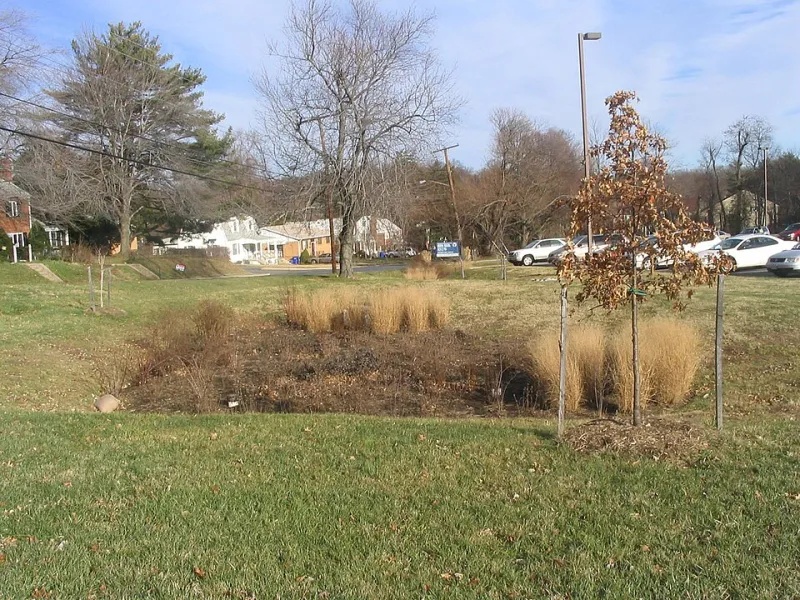
Photo: Moreau1, Public domain, via Wikimedia Commons
Every garden has one: the corner where the grass gives up. Usually it sits below a downpipe, the soil is compacted and pale, and by February it squelches underfoot while the rest of the lawn is merely damp. Most of us treat that patch as a problem to be paved over. It is actually a free water supply with a design flaw attached.
A rain garden is the fix. Not a pond, not a bog, not a mini wetland that needs a liner and a pump — just a shallow planted basin that takes roof runoff, holds it for a few hours, and lets it drain away through the soil. Done properly it deals with the wet corner and gives you a border full of things you could not otherwise grow.
Start with the maths, not the plants
A modest UK roof section of 40 square metres will collect something in the region of 30,000 to 35,000 litres of rain across a year. Most of that arrives in a handful of heavy spells, which is why your downpipe overwhelms the lawn in a way that steady drizzle never does.
A useful rule of thumb is to make the planted basin roughly 5 to 10 per cent of the roof area feeding it. So a 40 square metre roof calls for something between 2 and 4 square metres of rain garden — about the size of a small dining table, not a whole border. Depth matters too: aim for a basin that ponds 100 to 150mm at the low point, with 150 to 200mm of improved soil beneath it. Any deeper and you have built a sump that sits full for days.
If you are draining more than one downpipe into the same garden, add the roof areas together before you size it. And if your garden is on heavy clay, keep to the smaller end of that range and lean on the overflow route instead — more on that below.
Redirecting the downpipe without soaking the house
This is the part where enthusiasm causes expensive problems, so take it slowly.
- Keep the basin away from the walls. Two to three metres from the house is comfortable. If you simply have not got the space, use a lined basin with a piped inlet and outlet rather than letting water sit against the foundations.
- Give the pipe a fall. A 110mm pipe wants roughly 1:80 — about a 12mm drop per metre. Flexible corrugated pipe will happily sit in a dip and hold water, so use rigid pipe for the run and keep the bends gentle.
- Never run water towards a neighbour. Redirecting runoff so it flows onto someone else's land can become a nuisance claim. Point the overflow at your own lawn, a border, or a soakaway within your boundary.
- Think about where the water enters. A pipe end dumped on bare soil scours a hole in a fortnight. Finish the run with a short length of pipe set into a gravel-filled pocket, or a shallow pebble apron that spreads the flow.
- Check your drains before you cut anything. If the downpipe currently feeds a combined sewer, keep an overflow connection to it so that extreme storms have somewhere to go. If you plan to alter a connection to a public sewer, talk to your water company first.
The whole job is a couple of hours with a pruning saw, some pipe and a bag of gravel. What takes longer is deciding where the water should go once the garden has had its fill.
Overflow: plan for the storm you did not plan for
The most common failure of a DIY rain garden is not the planting or the digging — it is a basin with nowhere to send a February downpour. Once the soil is saturated, the water has to move somewhere, and if that somewhere is a low patio or an air brick, you will regret it.
Options, in rough order of cost:
- A shallow overflow channel across the garden to a lower lawn area or planting bed.
- A raised overflow pipe in the basin, set 50mm below the rim, discharging to a gravel-filled trench or a soakaway crate.
- A soakaway sized to take the surplus. Clay soils need a bigger one, or a pumped solution.
Test it before you plant. On a dry day, run a hose into the basin at full pressure for twenty minutes and watch where the water goes when it fills. Better to find the weak point now than at 7am on a Sunday in January.
Choosing plants that can handle the pendulum
Forget plants sold as bog plants. A rain garden is wet for hours, then dry for weeks, and only a specific group of plants enjoys both. Look for tolerant, deep-rooted, clump-forming things that will not sulk in August.
Grasses and sedges do the heavy lifting: pendulous sedge (Carex pendula), tufted hair grass (Deschampsia cespitosa) and purple moor grass (Molinia caerulea). They knit the soil surface, hold the basin shape and look good well into winter.
Flowering perennials for colour: Siberian iris, purple loosestrife, meadowsweet, Persicaria amplexicaulis, masterwort and ragged robin. These will give you movement from June onwards and cope with both extremes.
Structure at the edges: a dwarf willow, a clipped dogwood for winter stems, or royal fern if you have shade. Keep anything vigorous out of the middle of the basin, where it will silt up.
Plant densely — bare soil in a basin becomes a weed nursery and a silt trap. A mulch of 50mm of gravel or coarse compost over the surface stops the soil capping and makes the whole thing look deliberate rather than unfinished.
Maintenance that actually matters
A rain garden is low-maintenance, not no-maintenance. Four jobs cover it:
- Autumn: clear leaves from the inlet and the basin. A single sycamore can block a 110mm pipe in a week.
- Late winter: check the overflow is clear and the basin is draining within 24 to 48 hours of a storm. If it is still full after two days, the soil is capped or the base is compacted — fork it over and add grit.
- Spring: cut back the grasses and perennials, leaving a few stems for insects, and top up the mulch.
- Every few years: lift the silt that collects at the inlet point. It is free topsoil for the rest of the garden.
One thing to resist: walking across the basin in winter. Compaction is what kills rain gardens, and a path worn through the middle will turn a functioning soakaway into a puddle.
What it costs
Doing it yourself, with a spade, a barrow of compost, some rigid pipe and a dozen 9cm plants, you are looking at £150 to £400 depending on how generous you are with planting. A landscaper installing a properly sized basin with a soakaway and a mature plant schedule will typically quote £1,200 to £3,000.
Set against that: a corner of the garden that stops being a mud bath, a border that survives drought because it sits over moisture-holding soil, and a downpipe that stops hammering your lawn every time the sky opens. For a soggy patch you were never going to solve with grass seed, that is a reasonable trade.