Look Up, Look Out: Designing a Compact UK Garden Around the View You Don't Own
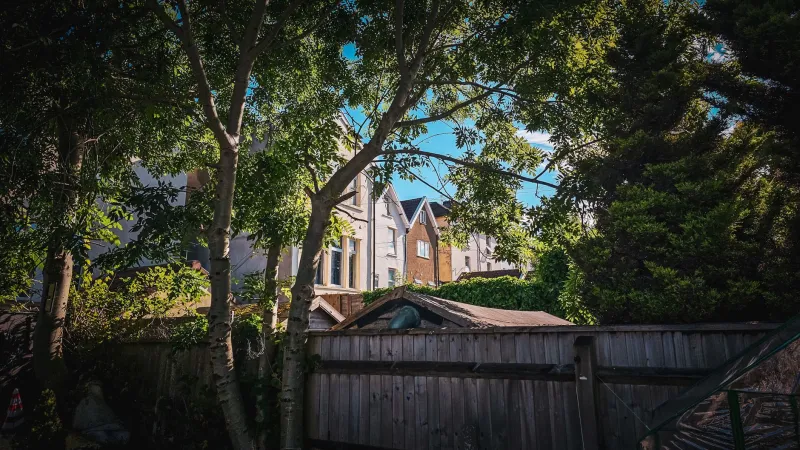
There's a moment, standing at the back door with a mug of tea, when most of us look straight down at the patio and think: right, that needs sorting. Fair enough. But before you start pricing up fence panels, try looking up instead. Because the best thing about a small UK garden is often the bit you didn't pay for — the oak two doors down, the church tower poking above the rooftops, the line of allotment poplars at the end of the terrace.
Designers call it a borrowed view. The Japanese have a word for it, shakkei, and landscape architects have been pinching the idea for centuries. The principle is simple: if you can see it, you can design with it. Your garden doesn't stop at the fence — it just changes ownership.
Why the view next door can work harder than another fence panel
A small garden feels small because the eye runs out of things to look at. You hit the boundary, the boundary hits you back, and the whole space reads as a box. Raise the fence and you've made a taller box. Nothing has changed except the light.
Give the eye somewhere to travel, though, and the brain does something lovely: it stops counting square metres. A mature silver birch hanging over a neighbouring garage, a distant band of woodland, even a well-proportioned roofline — these things add depth and distance for free. In a suburban garden of, say, six by eight metres, that psychological extra room is worth more than any clever paving pattern.
Start by standing still and looking out
Before you buy anything, do a proper sightline audit. It sounds grand; it takes ten minutes. Stand at the kitchen window, the back door, your main seating spot and the far end of the garden. Take a photo from each. Note what you see at eye level and what you see above the fence line.
Then split the view into three lists: things worth keeping, things worth framing, and things worth blocking. That church spire is a keeper. The neighbour's wheelie-bin store is a blocker. The mature ash behind the shed is probably both — lovely in summer, less so when it drops its leaves in your gutter, but we'll come to that.
The fence-height question
Here's where ambition meets the rules. In England and Wales, a fence over two metres tall generally needs planning permission — and it's one metre if it borders a highway. Scotland and Northern Ireland have their own variations, so check with your local council before you order anything. There's also the small matter of who owns the boundary; the deeds will tell you, and it's worth knowing before you start drilling.
But the more useful point is a design one. A tall, solid fence doesn't just block the view — it blocks the light, traps wind, and can make a small garden feel like a compound. Very often the smarter move is a lower fence with a slatted or hit-and-miss top section, or a trellis run along the top of an existing panel. You keep the privacy at sitting height, and you let the borrowed view do its work above it.
Frames, gaps and the art of the deliberate peek
Once you've decided what's worth keeping, frame it. A frame is any device that narrows the view and makes the eye slow down: an arch, a rectangular gap between two shrubs, a slim opening in a slatted screen, a neatly clipped window in a hedge.
Line that frame up with the thing you want to see. A gap in a yew hedge aimed at the church tower will do more for your garden than a whole border of bedding plants. On a smaller scale, a pair of multi-stem birches either side of a bench creates a natural frame, and the borrowed view slots neatly between them.
Layering your side of the boundary
The trick to making a borrowed view feel intentional rather than accidental is to plant in your own garden as if the borrowed element were part of the composition. That means tiers: low planting at the front, mid-height shrubs behind, taller loose shapes at the boundary, then the borrowed tree or roofline above. Repeat a colour or leaf shape from the view into your own planting — a purple-leaved shrub echoing a copper beech next door, say — and the join disappears.
Avoid the temptation to run a single, uniform hedge along the back. A mixed boundary — evergreen structure, a few taller specimens, some seasonal interest — is more forgiving, more wildlife-friendly, and it lets glimpses through.
Privacy without a blockade
Good neighbours matter more than good design, and the two usually agree. If you're planning to raise a boundary, have a word first. Check whether your changes will shade their windows or block their light, and be honest about it. There's no legal right to a view in UK law, but there is such a thing as being the neighbour who built the wall.
A layered approach works better than height alone: fence panel at the base, trellis above, climbers on your side only, and a couple of tall shrubs positioned where they screen a specific window rather than the whole skyline. Keep ivy and other vigorous climbers trimmed on your side of the boundary; nobody thanks you for a maintenance job they didn't ask for.
When the view is a bin store or a pylon
Not every borrowed view is a gift. For the genuinely ugly, think selective screening rather than total blockade. Raise the eyeline with a raised bed of tall grasses, a pergola draped in climbers, or a multi-stem tree in a large pot. Block the specific thing, not the whole horizon — otherwise you're back in the box again.
The seasonal test
Borrowed views change with the seasons, and a garden designed in July can look bare in February. A neighbour's deciduous tree gives you six months of green and six months of twig. That's fine, as long as your own garden has enough evergreen structure to carry the winter. Take a photo of the view in midwinter before you commit — it's the cheapest design check you'll ever do.
A quick checklist
- Audit your sightlines from windows, doors and seats, not just from the patio.
- List what to keep, frame and block.
- Check boundary ownership and local fence-height rules before ordering.
- Consider a lower fence with a slatted or trellis top rather than a solid wall.
- Use arches, hedge windows and paired trees to frame the good stuff.
- Layer your planting so your garden and the borrowed view read as one scene.
- Talk to the neighbours first. Always.
Get it right and the effect is quietly transformative. You haven't gained a centimetre of land. You've just stopped treating the fence as the end of the story.