Out of Sight, Still Easy: Giving Bins a Proper Place in Your Garden Plan
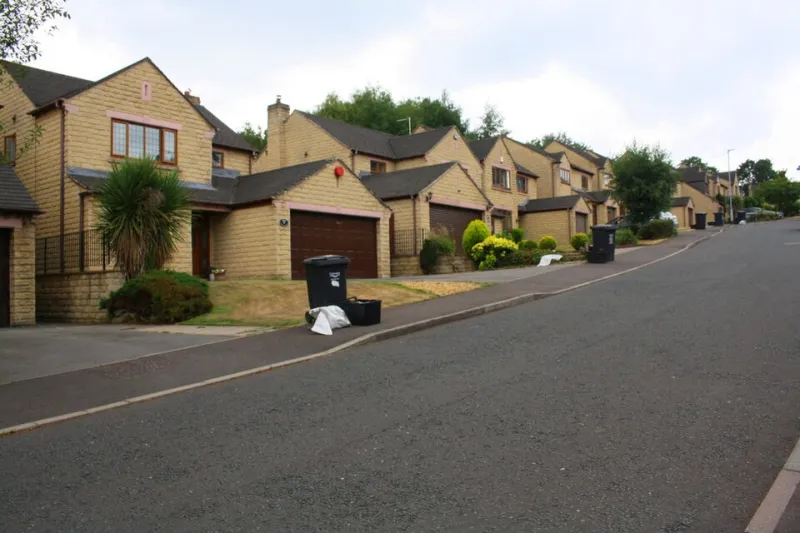
Photo: Roger Templeman , CC BY-SA 2.0, via Wikimedia Commons
Start with the journey, not the box
Most bin storage goes wrong because it begins with a shed or a screen rather than the route. Before you buy anything, walk the bin-day journey yourself. Start at the kitchen door, follow the path to the back gate, then out to the kerbside. Note every threshold, step, tight turn and soft patch of lawn. A 240-litre wheelie bin is roughly 58–70cm wide and 110cm tall, and it is much less charming when you are dragging it through a 700mm gap in the rain.
Aim for a clear route of at least 800–900mm. Gates should ideally be 900mm wide; if yours is narrower, measure carefully before assuming a standard bin will fit. Avoid two tight 90-degree turns in succession. If the route crosses grass, add a reinforced path or a line of broad stepping stones. The best bin store in the world is useless if the journey to it churns the lawn into a mud track every Thursday morning.
A pad that can take the weight
Bins are heavy, especially the garden waste one after a wet fortnight. Give them a proper hardstanding rather than a patch of bare soil or loose gravel. A compacted sub-base of 50–75mm, topped with paving, resin-bound gravel or a gravel grid, will stop the wheels sinking and make cleaning far easier. On clay soil, dig out and use a proper MOT Type 1 base rather than hoping for the best.
Make the pad slightly larger than the bins, with around 10cm of clearance on each side. A gentle fall away from the house and towards a drain or border helps rainwater run off instead of pooling underneath. If the store sits against a wall, leave an air gap. Damp bins smell faster, and damp screens rot faster. A simple hook or bungee cord for the lid is a small detail that pays off on windy collection days.
Screens that earn their keep
Screening should hide the bins without hiding the fact that you need to use them. Slatted timber screens look smart and let air through. Trellis with evergreen climbers softens the edge in small gardens. A low yew or holly hedge takes longer to establish but ages beautifully and doubles as a wildlife-friendly boundary. Willow and reed screens are budget-friendly, though they need replacing sooner.
Whatever you choose, design in access. A hinged panel, a removable section or a pair of outward-opening doors will save you from wrestling a bin into a box that only looks good from the house. Keep the screen far enough away for the lid to open fully. In a side return, line the store up with the wall and use the same fencing material as the boundary so it reads as part of the garden rather than a bolt-on. If space is tight, a combined bike and bin store can earn its footprint, but only if the bikes can still come out without moving every box.
The smell and cleaning bit
Bins smell because food waste, warmth and moisture get together. Keep lids closed, rinse the bin weekly, and use a little bicarbonate of soda in the bottom. Council-approved caddy liners help more than loose scraps. Position the store with some airflow and drainage, and avoid tucking it directly beside the kitchen door where every summer waft lands on the dining table.
For cleaning, a small hardstanding with a slight fall is your friend. Hose the bin out, scrub with a stiff brush and mild detergent, then let it dry with the lid open. Do not wash bin water straight onto the lawn; send it to a drain or a gravel-filled soakaway. A nearby outdoor tap makes the whole job less of a production. If the store is in shade, that is fine for comfort, but check it dries out between collections.
Gate widths, kerbside handover and the front garden
Check your council's collection rules before you finalise the design. Some collect from the kerbside only; others offer assisted collections. Keep the bin near the gate on collection day without blocking the pavement. A house number on the lid is a small kindness to the collection crew and to your neighbours.
If the front garden is the only storage option, treat it as part of the design. A timber store with a sedum roof, a matching planter or a slim hedge can turn a necessary utility into a feature. Avoid steps on the bin route if you can; if the ground slopes, a gentle ramp is better than a lift-and-drag manoeuvre. In terraced streets and side returns, every centimetre counts, so measure the gate, the path and the turning circle before you commit.
A quick design checklist
- Walk the route from kitchen to kerb with a full bin in mind.
- Measure the narrowest gate and the tightest turn.
- Fit a level, free-draining hardstanding.
- Choose a screen with genuine access and lid clearance.
- Leave air gaps and a cleaning point.
- Plan where the bin waits on collection day.
- Match materials to the house and garden so storage looks deliberate.
Bins are not the enemy; bad planning is. A few measurements, a proper pad and a screen that opens easily can make waste storage disappear from view without making it inconvenient. In 2026, as more UK homes squeeze storage into side returns and compact back gardens, that is one of the most useful design moves you can make.